


What Technical SEO Actually Fixes on a Bathroom Ecommerce Site (Not the Textbook Definition)
Quick answer: If you’re comparing a technical SEO audit service for a bathroom, tile or kitchen ecommerce site, here’s what a proper audit actually finds — not a dictionary definition. It’s four recurring problems: filter combinations multiplying into thousands of duplicate URLs, product photography too heavy for mobile, missing or broken schema on tap, bath and tile listings, and sitemaps that go stale after a bulk upload. We’ve run technical SEO for ecommerce sites in this exact vertical for seven years, and it’s almost always one of these four.
If you’ve already read a “what is technical SEO” explainer, skip it. This is what we find when we open a UK bathroom, tile or kitchen retailer’s site.
Faceted navigation SEO: your filters are multiplying out of control
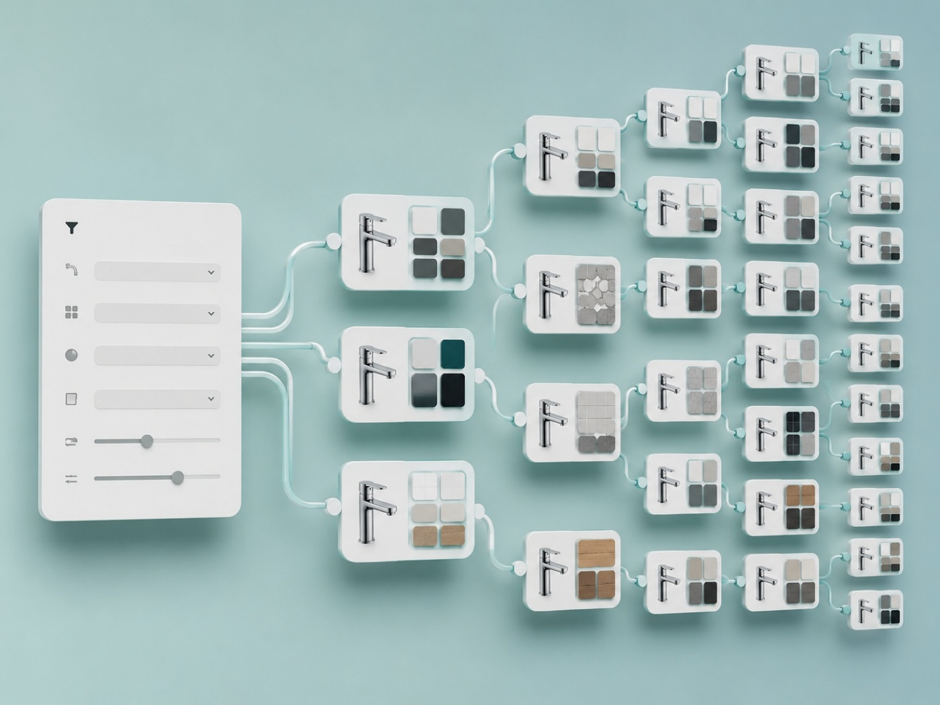
A tap range with four finishes, a bath panel in three sizes and two colours, a tile collection in six finishes and four sizes — multiply that across a catalogue and you get tens of thousands of filtered URLs, most showing the same handful of products with a different swatch highlighted.
Google crawls every one. Each is a near-duplicate of the category page above it, which dilutes the ranking signal that page should be earning and burns crawl budget on pages nobody will ever click.
| Filter combination | Typical URLs generated | Worth indexing? |
| Colour only | 4–8 per category | Sometimes, if UK search volume exists |
| Size only | 3–6 per category | Rarely |
| Colour + size | 12–48 per category | Almost never |
| Colour + size + finish + brand | 100+ per category | Never |
Faceted navigation SEO isn’t about switching filters off — customers need them. It’s deciding, filter by filter, which combinations deserve a real indexed page and canonicalising or noindexing the rest. This is the single highest-impact fix we make on filter-heavy bathroom and tile catalogues, and it’s exactly what our filters and categorisation service is built to sort out.
Product schema markup: why your tap or tile listing isn’t getting the rich result
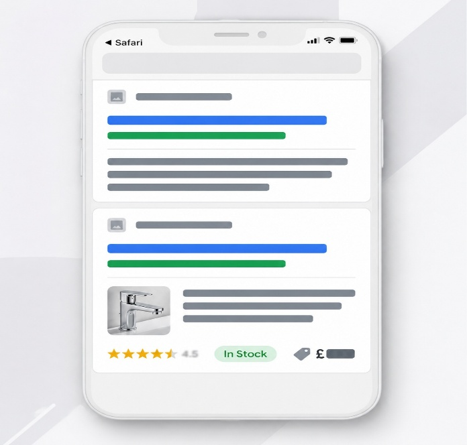
Search for a tap, a bath or a tile range on Google, and results with star ratings, price and stock status win the click. Without product schema markup, your listing is plain text beside a competitor’s rich result — same position, far fewer clicks.
Three problems show up repeatedly on UK bathroom and tile product pages:
- No schema at all — common on older WooCommerce builds or customised Elementor templates.
- Schema present but incomplete — price or availability missing, which blocks the rich result even though markup exists.
- Schema copied from a template and never updated per product – a discontinued range still showing “in stock,” which risks a Merchant Centre suspension, not just a ranking one.
- Getting schema right at the point of product listing and uploading is far cheaper than retrofitting it across a few thousand SKUs later.
Site speed: chrome close-ups and room-set photography are slowing you down
Bathroom and tile ecommerce runs on photography — chrome finish close-ups, tile texture shots, room sets. It’s also the most common cause of slow product pages we see. A single unoptimised room-set image can run 3–8MB; put six on one gallery page and mobile load time on a typical UK connection stretches past the point where Google, and the customer, gives up.
We check: whether images serve as WebP/AVIF with a fallback, whether a smaller image loads on mobile via srcset, whether gallery images lazy-load below the fold, and whether a review widget or chat script is blocking the largest image from rendering. This comes up constantly on Shopify stores specifically — none of it needs a rebuild, usually a compression pass and reordering two or three scripts.
Orphaned pages and bulk uploads: what happens when a range changes
When a bathroom or kitchen range is discontinued, the product pages often just stay – no redirect, no sitemap update. Google keeps crawling a dead end, and so does any customer who lands there from an old link.
The same risk runs the other way. When a new tile or radiator range goes live – 40, 100, sometimes 300 SKUs in one batch – the sitemap can fail to regenerate, canonical tags can point at a staging URL, or new products can go live with no internal links pointing at them. None of this is visible on the storefront. It only shows up when you check Search Console’s coverage report against what was actually uploaded.
What we’d fix first for a UK bathroom, tile or kitchen retailer

Any technical SEO audit UK retailers commission this year should prioritise in this order: image weight on your top 20 product pages by traffic, schema on any page missing price or availability, faceted URL indexing rules across your worst-offending categories, then a standing redirect process for retired ranges – the same process covered under our website maintenance work. That order gets visible wins fast, then fixes the structure underneath.
Frequently asked questions
What is a technical SEO audit?
A technical SEO audit is a review of how well search engines can crawl, index and rank your site – for a bathroom or tile retailer, that means checking filter URLs, product schema, image weight, mobile usability and sitemap health, not just a generic checklist.
How do I choose the right technical SEO agency?
Choose an agency that can show vertical experience, not just general SEO claims – ask what they’ve found on sites like yours before, ask for specifics rather than percentages, and be wary of anyone promising guaranteed rankings within a fixed timeframe.
How long does a technical SEO audit take?
The time it takes depends on catalogue size and how deep your filters go – small catalogues in days, larger ones in weeks.
How much does a technical SEO audit cost?
Cost depends on catalogue size and how deep the faceted navigation goes, since that’s usually the most time-consuming part to map properly. Ask for a fixed-scope quote rather than an hourly estimate, so you know what’s actually being checked.
How do I know if I need one?
The clearest signal is Search Console showing strong impressions on your category or product pages with very few clicks — that pattern usually means pages are being found but ranking too low to get clicked, which is exactly what technical issues cause.
Get a technical SEO audit built for your catalogue
If your bathroom, tile or kitchen ecommerce site is getting found but not clicked, this is usually where the gap is. We’ve run technical SEO audit service work across this vertical in the UK for seven years – get in touch and we’ll tell you which of the problems above is costing you the most.
James Carter is a Senior Ecommerce Strategist at Ecommerce Experts UK, with 7 years of hands-on experience helping UK online retailers build faster, more profitable stores. He specialises in Shopify, WooCommerce and Magento - with a particular focus on the UK bathroom, heating and home sectors. James works with UK store owners on everything from website maintenance and technical SEO to platform migrations and site speed — helping them protect revenue, improve rankings and fix the issues that silently cost sales every single day.