


How to Write Product Pages That Rank – A Bathroom, Kitchen & Tile Ecommerce Guide
Product pages rank when they tell a buyer whether the product actually suits them — will it fit, what’s included, how it compares to the standard spec — not when they just repeat the manufacturer’s copy word for word. That’s the short version; here’s why it matters more than most retailers think.
Category pages get most of the SEO attention on a bathroom, kitchen or tile ecommerce site. Product pages get whatever’s left usually the manufacturer’s spec sheet, copy-pasted, published, and forgotten. That’s backwards. A shopper searching for a specific model, size or finish lands on a product page, not a category page. If that page can’t rank, that specific, high-intent sale never has a chance of coming through search at all. This guide is about seo for ecommerce product pages specifically — not general ecommerce SEO, not technical fixes, just the content and structure of the page itself.
Why Supplier-Fed Product Pages Don’t Rank
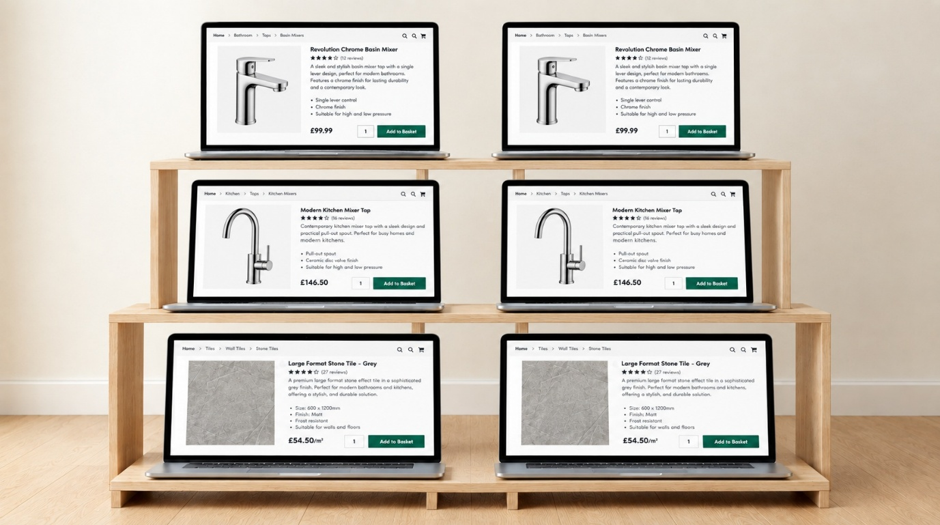
Here’s the mechanic: if a retailer publishes the manufacturer’s product description exactly as supplied, and three other UK retailers stock the same tap, shower enclosure or tile and do the same thing, Google is looking at four near-identical pages. There’s no signal telling it which one to prefer, and no reason to rank any of them highly over a page that’s genuinely different.
This is a bigger problem for bathroom, kitchen and tile retailers than most other verticals, because so much of the catalogue comes directly from a handful of major manufacturers whose product data is designed for distribution, not differentiation see our case study on fixing corrupted product data across a 5,000-SKU catalogue for how far this can go wrong when it’s left unchecked. Every retailer gets the same feed. The ones who rank are the ones who do something with it beyond publishing it as-is true for a small storefront running a modest seo for ecommerce website setup, and just as true when auditing seo for ecommerce websites at scale with thousands of SKUs.
What an Optimised Product Page Actually Needs
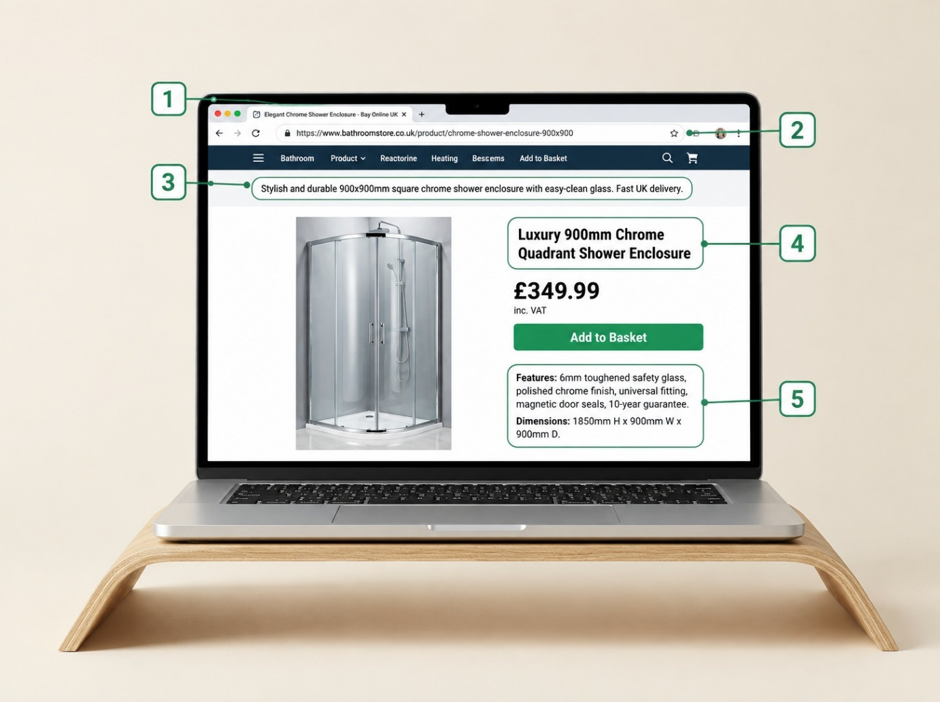
Strip it back to the essentials, because this is where most of the ranking opportunity sits:
- A unique title tag — not just the product name, but the product name plus a distinguishing detail (size, finish, key feature) that separates it from how competitors title the same item.
- A unique meta description — written to answer the actual question a searcher has, not a rehash of the title.
- One clear H1 — matching the title tag’s intent, not a generic “Product Details” heading.
- A description that answers a real buyer question does this fit a small bathroom, is it suitable for a wet room, what’s the warranty — rather than a restated spec list.
- Accurate specs kept intact — dimensions, materials, IP ratings. Differentiation is about the writing around the specs, not inventing new technical claims that aren’t true.
- A URL that matches the product name — not a raw SKU or auto-generated ID string. If the title changes later (a rename, a rebrand), update the URL and redirect the old one rather than leaving a mismatch.
This is the practical core of seo for ecommerce product pages, one piece of the wider on-page SEO picture. Get these five things right consistently, and a supplier-fed catalogue stops being a liability.
Writing Unique Descriptions at Scale (Without Losing Accuracy)
The obstacle most retailers hit isn’t knowing what a good product page looks like — it’s doing that hundreds or thousands of times without it becoming unsustainable. A templated but flexible structure solves this:
- Product name — clear, matching how buyers actually search (model + key distinguishing detail)
- Buyer-focused description — length isn’t fixed. Say what actually helps the buyer decide, then stop
- Dimensions — exact measurements, called out clearly, not buried in a spec table
- Key features — 3-5 bullet points, the genuine differentiators (finish, mounting type, standout functional detail)
- Additional info — installation notes, care instructions, compatibility details
- What’s included — exactly what ships in the box (fixings, waste kit, brackets), since this is one of the most common pre-purchase questions and rarely answered clearly on supplier feeds
Illustrative example (generic, not a real product or client — shown to demonstrate the method):
Typical supplier-feed description:
“800mm shower enclosure. Chrome frame. 6mm safety glass. Reversible fitting. Suitable for recess or corner installation.”
Rewritten using the template:
“800mm Chrome Shower Enclosure — Compact Fit for Small Bathrooms
Designed for bathrooms where space is tight, this 800mm enclosure fits neatly into a recess or corner without overwhelming the room.
Dimensions: 800mm x 800mm x 1900mm height
Key features: 6mm toughened safety glass, reversible left/right fitting, polished chrome frame, easy-clean glass coating
Additional info: Suitable for recess or corner installation; professional fitting recommended for full warranty cover
What’s included: Glass panels, chrome frame and fixings, wall seals, fitting instructions — waste kit sold separately”
Same underlying spec data, but the second version answers “will this fit my bathroom,” states dimensions clearly, and tells the buyer exactly what arrives in the box — none of which the original supplier copy does.
This is exactly the kind of work genuine seo services for ecommerce should include as standard — not a one-off content sprint, but a repeatable process that scales with the catalogue as it grows or changes.
One rule worth being strict about: never publish a manufacturer’s description verbatim across multiple retailer sites. Even a modest rewrite — reordering the specification, adding a line about who the product suits, noting a genuine installation consideration — is usually enough to differentiate a page without inventing anything inaccurate.
On scope: rewriting a large catalogue isn’t a weekend job, and it doesn’t need to be done all at once. A realistic pace is a batch of highest-traffic or highest-margin products at a time, either in-house or with a dedicated freelancer working from the template above — treat it as an ongoing content operation, not a one-off project with a fixed end date. It’s also worth remembering this isn’t purely an SEO exercise: a description that clearly states fit, suitability and what’s included tends to reduce returns and support desk queries too, alongside any ranking benefit.
Where Product Pages Meet the Rest of Your SEO
Good product page content doesn’t work in isolation. Schema markup, page speed and crawlability all affect whether a well-written product page actually gets seen and indexed properly — that’s a technical layer, covered in depth in our technical SEO guide for bathroom and tile ecommerce sites rather than repeated here. Genuine customer reviews sit in the same category: real reviews, marked up with review schema, can show star ratings directly in the search result, which affects click-through as much as ranking position does. The short version: getting ecommerce for seo right is a full-stack job, not just a writing task, and product page content is the half of it that’s most commonly neglected.
Quick Checklist
- Every product page has a unique title tag and meta description
- No manufacturer description is published verbatim
- Descriptions follow a consistent structure: name, buyer-focused summary, dimensions, key features, additional info, what’s included
- Technical specs (dimensions, materials, ratings) stay accurate
- A repeatable template exists for scaling descriptions across the catalogue
- Product page content is reviewed when a new product range goes live, not just at initial upload
- Genuine customer reviews are collected and marked up with review schema where possible
FAQs
This is a genuine, commonly reported issue on Shopify: editing a meta description on one product can appear to overwrite it across an entire collection, because Shopify’s collection URLs and canonical tags point back to the same underlying product. The fix is to edit the meta description through the product’s own “Search engine listing preview” (not the collection view), and to check your theme isn’t generating collection-scoped URLs for the same product – a Shopify Partner confirmed this in a real merchant thread on Shopify’s community forum.
There’s no fixed ideal count, and treating it as a number to hit is the wrong approach. Store owners often ask this question, but keyword count matters far less than whether the description naturally answers the buyer’s real questions about fit, suitability and what’s included. Mention the keyword once or twice in the description, plus once in the meta description.
Forcing a specific keyword count often creates worse, less natural copy. Instead, write for the buyer first.
Yes, generally, with clear “out of stock” messaging. Removing the page entirely throws away the ranking equity it has already built, and ecommerce SEO widely recognises this as a mistake, not a niche concern.
If you permanently discontinue a product, redirect the page instead of leaving it live and orphaned.
The content principles are the same across platforms. The main practical difference is how each platform handles bulk description templates, canonical URLs and variant data, which affects how efficiently a consistent structure can be applied at scale.
Yes, but prioritise — start with your highest-traffic or highest-margin categories rather than trying to rewrite everything at once. A templated approach makes this manageable even across thousands of SKUs.
Need help auditing or rewriting your own product pages? See our SEO services or find out how we handle product listing and uploading for ecommerce retailers.
James Carter is a Senior Ecommerce Strategist at Ecommerce Experts UK, with 7 years of hands-on experience helping UK online retailers build faster, more profitable stores. He specialises in Shopify, WooCommerce and Magento - with a particular focus on the UK bathroom, heating and home sectors. James works with UK store owners on everything from website maintenance and technical SEO to platform migrations and site speed — helping them protect revenue, improve rankings and fix the issues that silently cost sales every single day.