


How We Fixed a 5,000-SKU “AI Data Disaster” and Restored Growth for a UK Bathroom Retailer
In the rapidly evolving landscape of 2025–2026 digital retail, the “AI Promise” has become a central narrative. For many UK merchants, the prospect of using Generative AI to automate the creation of thousands of product Title, feature(size,colour) and descriptions from SKU in minutes sounds like the ultimate efficiency hack. However, for a high-growth bathroom retailer we recently audited, this promise quickly transformed into a commercial nightmare.
As a leading Ecommerce catalog management UK specialist, we witnessed firsthand the “AI Hallucination” trap. The retailer had tasked an AI tool with generating a massive CSV file for their new product range. On the surface, the site looked professional; in reality, the underlying data was corrupted. Sizes were wrong, technical certifications were missing, and the site’s search filters were broken.
This article dissects the Hidden cost of AI product Title, feature and description errors and provides a roadmap for Fixing corrupted CSV product listings to restore customer trust and revenue.
The “Dirty Data” Epidemic in UK Ecommerce
The current UK market shows a massive “maturity gap.” While approximately 88% of businesses have adopted AI in some form, only 7% have a mature framework for managing its outputs . In technical sectors like bathrooms, heating, and plumbing, this lack of oversight leads to “Dirty Data” information that is technically plausible but factually incorrect.
Why AI fails at technical product specs
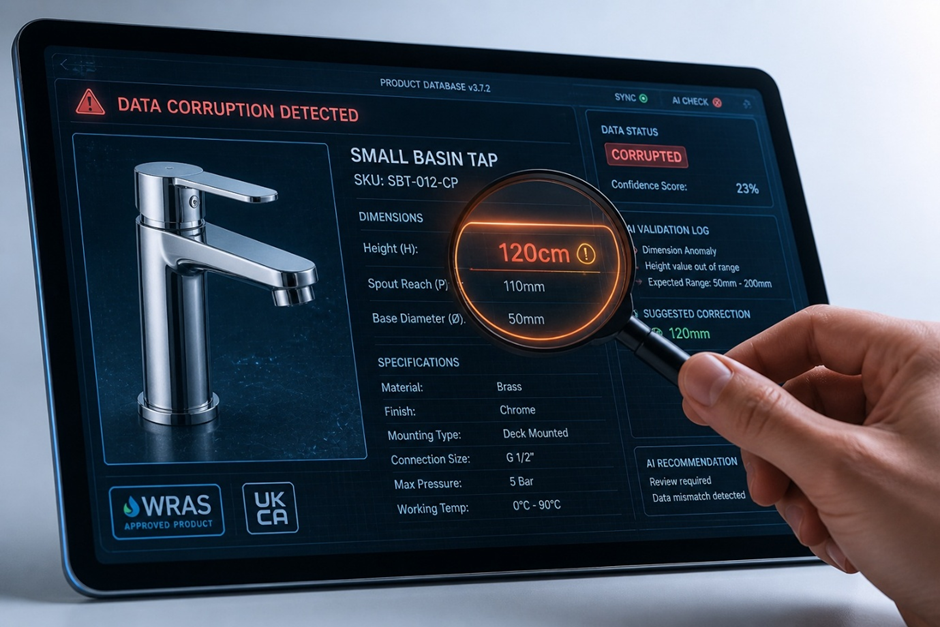
Unlike fashion or lifestyle products, bathroom fixtures require absolute precision. A general-purpose AI model often struggles with “Domain Knowledge”. It may understand the word “shower,” but it does not understand the critical difference between a thermostatic mixer and a manual valve, nor does it grasp the nuances of UK water pressure requirements.
One of the most common issues we encounter is mm vs cm listing mistakes. An AI might parse a technical PDF and incorrectly list a 1200mm shower enclosure as 120cm in one field and 12cm in another. For a customer planning a precise installation, these discrepancies are instant deal-breakers.
3 Ways Inaccurate Data is Sabotaging Your ROI
When a retailer’s product catalog is built on a foundation of errors, the financial damage is rarely visible on the surface. It manifests as a “visibility ceiling” where rankings remain high, but conversions and impressions stagnate.
- The Impact of inaccurate SKU data on conversion
In the bathroom industry, “range accuracy” is a higher driver of purchase than price . If a customer sees a “brushed brass” tap but the technical specifications tab mentions a “chrome finish” (a common AI hallucination), they will abandon the cart. This confusion erodes brand reputation and increases customer support inquiries, as buyers are forced to call and ask, “Which detail is correct?” - Reducing ecommerce returns with accurate data
Inaccurate product information is responsible for roughly 23% of all ecommerce returns . For bulky, high-value bathroom items like freestanding baths or stone shower trays, the cost of a return is catastrophic. Between restocking fees, potential damage in transit, and lost outbound shipping costs, “Dirty Data” is a silent margin killer. - Broken Faceted search attribute mapping
Modern shoppers rely on filters to navigate large catalogs. If your AI tool mislabels a “Traditional” tap as “Modern” in your CSV upload, that product effectively becomes invisible to anyone using the site’s navigation filters. This leads to a poor user experience where customers cannot find what they need, even if it is in stock.
Case Study: Our 102-Point Ecommerce product data audit UK
When our recent client approached us, their growth had plateaued. Despite ranking for “luxury bathroom suites,” their total impressions were low because their product pages lacked the “citable facts” that modern search engines and AI assistants demand.

The Diagnostic Phase: Identifying the Corruption
We began with a comprehensive Technical product data optimization diagnostic. Using our proprietary 102-point checklist, we exported their full 5,000-SKU catalog to identify the scale of the AI-generated errors .
We found a series of systemic failures that were actively sabotaging the site’s performance:
• Corrupted CSV Uploads: The AI had completely failed the task of deriving product names and features from SKUs. We discovered hundreds of listings with incorrect product titles, wrong sizes, and hallucinated features. For example, a standard basin tap was titled as a “High-Pressure Rainfall Shower” simply because the SKU suffix contained a similar digit pattern. Additionally, colours were mismatched, with “Gold” products incorrectly tagged as “Brushed Brass,” leading to an inconsistent site appearance and severe customer confusion .
•WRAS approval listing errors: AI had missed the crucial “WRAS Approved” tag on 40% of their taps, leading B2B trade buyers who require certified components to ignore the products entirely .
• IP44 vs IP65 bathroom zones: Lighting fixtures were incorrectly categorised. AI had labelled Zone 1 shower lights as only IP44 (splash-proof) instead of the required IP65 (jet-proof), creating a significant safety and compliance risk .
• Broken Filters: 15% of the catalog had no “Material” attribute, meaning users searching for “Marble Tiles” were seeing zero results despite the warehouse being full of stock .
The Resolution: Human-in-the-loop data verification
Automation is a power tool, but it requires a human guardrail . Our team, each possessing over 7 years of industry-specific experience , performed a manual re-check of the entire CSV.
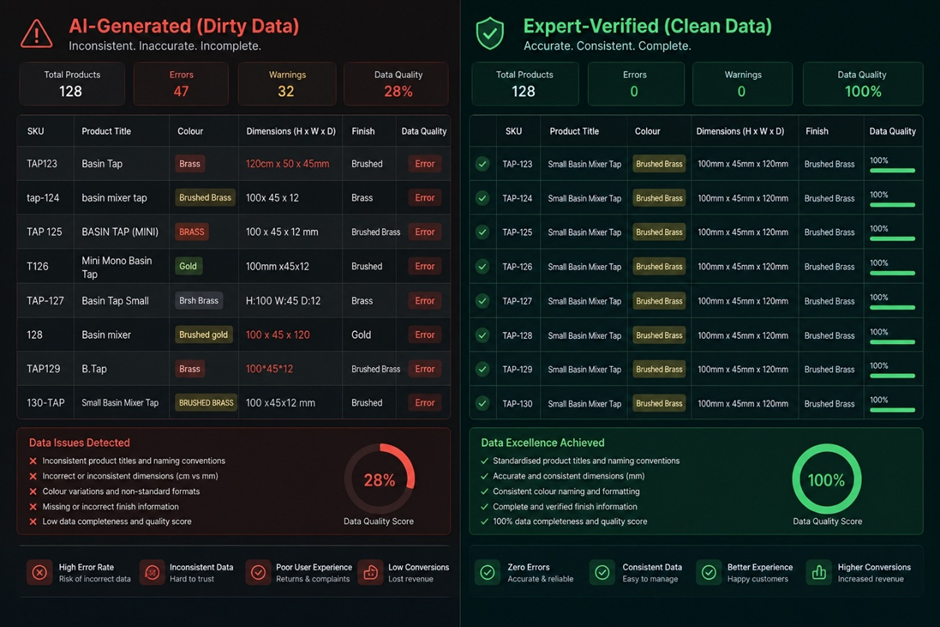
Our process for Fixing corrupted CSV product listings involved:
- Expert Data Export: Pulling the raw, “dirty” data from the client’s Shopify/Magento backend .
- Technical Cross-Referencing: Verifying dimensions, IP ratings, and finish codes against the original manufacturer’s technical sheets to fix the mm vs cm listing mistakes .
- Data Enrichment: Replacing generic, robotic AI descriptions with high-converting copy that answers the customer’s most pressing question: “Will this fit my project?” .
- Clean Re-upload: Ensuring the new SKU mapping and Faceted search attribute mapping were perfectly aligned with the site’s navigation .
Restoring Integrity through Bathroom product listing services
The result of this audit was a total transformation of the site’s performance. By providing accurate, parseable attributes, the retailer’s products began appearing in “AI Overviews” and “People Also Ask” boxes on Google . This shift from “generic content” to “authoritative data” is the key to solving the low-impression problem.
Why Authority Assets Matter in 2026
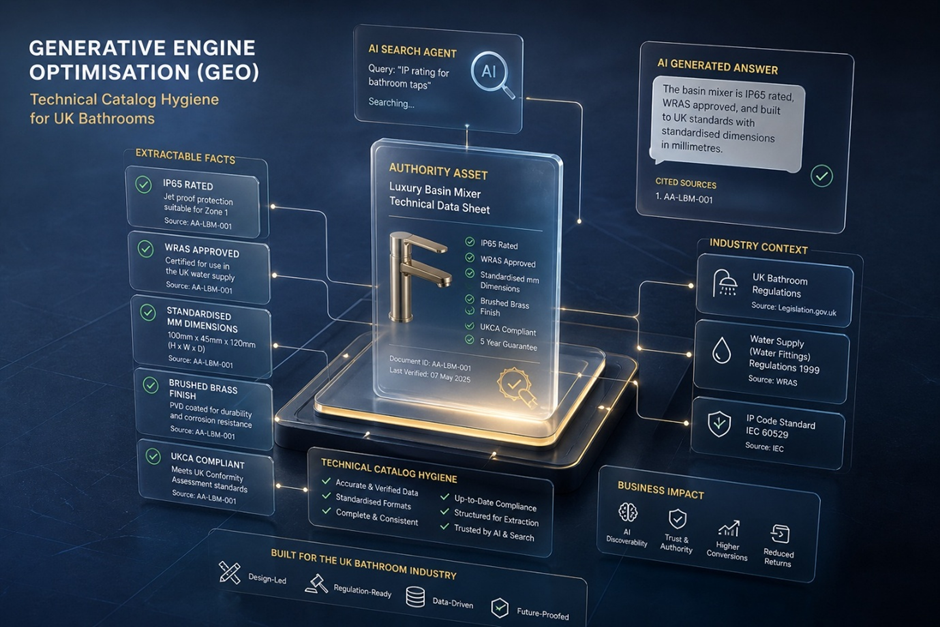
Search engines are now “Answer Engines” using Generative Engine Optimisation (GEO). AI models prioritize “extractable facts,” which explains Why AI fails at technical product specs when data is unstructured. Clean data ensures these models cite your brand as the expert source, solving the visibility paradox by driving impressions for technical specifications. AI agents now read Technical product data optimization signals titles and structured markup over visual content. By providing clear answers (e.g., “IP65”) and linking to your Faceted search attribute mapping, you capture high-value leads early.
Key Best Practices for Technical Catalog Hygiene
Avoid an “AI Data Disaster” and maximize Ecommerce catalog management UK efforts with these rules:
• Optimise Metadata: Lead with keywords in titles and descriptions to reduce the Hidden cost of AI product description errors.
• Standardise Formats: Use millimetres (mm) consistently to prevent mm vs cm listing mistakes.
• Verify SKU Integrity: Manual checks stop the negative Impact of inaccurate SKU data on conversion and assist in Fixing corrupted CSV product listings.
• Prioritise Compliance: Safety fields like WRAS approval listing errors and IP44 vs IP65 bathroom zones must undergo rigorous Human-in-the-loop data verification.
• Audit Seasonally: Conduct a professional Ecommerce product data audit UK bi-annually.
• Use Hubs: Host technical guides in an “Insights & Research” hub to keep Bathroom product listing services searchable for humans and AI bots.
Conclusion: Restoring the “Human Guardrail”
Artificial Intelligence is a revolutionary tool for scaling ecommerce operations, but it is not a replacement for industry expertise. In a technical niche like the bathroom industry, the speed of AI must be balanced with the precision of human oversight.
If your online store is suffering from low impressions or stagnant growth, the culprit is likely “Dirty Data.” By investing in Technical product data optimization and a rigorous Human-in-the-loop data verification process, you can eliminate conversion barriers and reclaim your position as a market leader.
Don’t let corrupted data sink your sales. Contact Ecommerce Experts UK today for a comprehensive Ecommerce product data audit UK. We specialise in Bathroom product listing services and high-level Ecommerce catalog management UK, ensuring your technical specifications are as flawless as your designs.
FAQ
1. How does structured product data impact my visibility in Google’s AI Overviews? Google’s AI Mode relies on your structured data feed rather than your website’s visual design . If your attributes are incomplete or inconsistent, the AI agent will skip your listing and recommend a competitor with cleaner, “extractable” facts.
2. Why is “Human-in-the-loop” verification necessary for technical products?
AI oftenstruggles with technical context, such as understanding which waste kit is compatible with which bath . Human experts catch subtle nuances and errors like mm vs cm listing mistakes that bots miss, protecting your brand from costly returns and customer support complaints.
3. What is the link between data accuracy and UK ecommerce return rates? Approximately 23% of returns are caused by incorrect product information . In the bathroom industry, where shipping is expensive, ensuring that dimensions, IP ratings, and finish descriptions are 100% accurate is one of the highest-return investments a merchant can make.
4. How do I optimize my store for “Zero-Click” search results in 2026? To appear in “People Also Ask” or AI snippets, your content must be formatted as structured facts . By providing clear, technical answers to common questions (e.g., “What IP rating is needed for Zone 2 lighting?”), you establish your brand as a “Cited Authority”.
5. Can clean product data improve my Google Shopping Performance?
Yes. Google promotes listings with accurate titles and standardised attributes . Mismatched identifiers or pricing will suppress your visibility, even if your bid is high. Accurate Ecommerce catalog management UK ensures your feed stays healthy and competitive.
James Carter is a Senior Ecommerce Strategist at Ecommerce Experts UK, with 7 years of hands-on experience helping UK online retailers build faster, more profitable stores. He specialises in Shopify, WooCommerce and Magento - with a particular focus on the UK bathroom, heating and home sectors. James works with UK store owners on everything from website maintenance and technical SEO to platform migrations and site speed — helping them protect revenue, improve rankings and fix the issues that silently cost sales every single day.